Medicine is the science and practice of the diagnosis, treatment, and prevention of disease. The word medicine is derived from Latin medicus, meaning "a physician". Medicine encompasses a variety of health care practices evolved to maintain and restore health by the prevention and treatment of illness. Contemporary medicine applies biomedical sciences, biomedical research, genetics, and medical technology to diagnose, treat, and prevent injury and disease, typically through pharmaceuticals or surgery, but also through therapies as diverse as psychotherapy, external splints and traction, medical devices, biologics, and ionizing radiation, amongst others.
Medicine has existed for thousands of years, during most of which it was an art (an area of skill and knowledge) frequently having connections to the religious and philosophical beliefs of local culture. For example, a medicine man would apply herbs and say prayers for healing, or an ancient philosopher and physician would apply bloodletting according to the theories of humorism. In recent centuries, since the advent of science, most medicine has become a combination of art and science (both basic and applied, under the umbrella of medical science). While stitching technique for sutures is an art learned through practice, the knowledge of what happens at the cellular and molecular level in the tissues being stitched arises through science.
Prescientific forms of medicine are now known as traditional medicine and folk medicine. They remain commonly used with or instead of scientific medicine and are thus called alternative medicine. For example, evidence on the effectiveness of acupuncture is "variable and inconsistent" for any condition, but is generally safe when done by an appropriately trained practitioner. In contrast, treatments outside the bounds of safety and efficacy are termed quackery.
Medicine has existed for thousands of years, during most of which it was an art (an area of skill and knowledge) frequently having connections to the religious and philosophical beliefs of local culture. For example, a medicine man would apply herbs and say prayers for healing, or an ancient philosopher and physician would apply bloodletting according to the theories of humorism. In recent centuries, since the advent of science, most medicine has become a combination of art and science (both basic and applied, under the umbrella of medical science). While stitching technique for sutures is an art learned through practice, the knowledge of what happens at the cellular and molecular level in the tissues being stitched arises through science.
Prescientific forms of medicine are now known as traditional medicine and folk medicine. They remain commonly used with or instead of scientific medicine and are thus called alternative medicine. For example, evidence on the effectiveness of acupuncture is "variable and inconsistent" for any condition, but is generally safe when done by an appropriately trained practitioner. In contrast, treatments outside the bounds of safety and efficacy are termed quackery.
Basic sciences
- Anatomy is the study of the physical structure of organisms. In contrast to macroscopic or gross anatomy, cytology and histology are concerned with microscopic structures.
- Biochemistry is the study of the chemistry taking place in living organisms, especially the structure and function of their chemical components.
- Biomechanics is the study of the structure and function of biological systems by means of the methods of Mechanics.
- Biostatistics is the application of statistics to biological fields in the broadest sense. A knowledge of biostatistics is essential in the planning, evaluation, and interpretation of medical research. It is also fundamental to epidemiology and evidence-based medicine.
- Biophysics is an interdisciplinary science that uses the methods of physics and physical chemistry to study biological systems.
- Cytology is the microscopic study of individual cells.

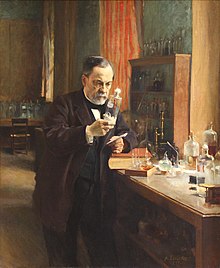
Louis Pasteur in his laboratory, 1885
- Embryology is the study of the early development of organisms.
- Endocrinology is the study of hormones and their effect throughout the body of animals.
- Epidemiology is the study of the demographics of disease processes, and includes, but is not limited to, the study of epidemics.
- Genetics is the study of genes, and their role in biological inheritance.
- Histology is the study of the structures of biological tissues by light microscopy, electron microscopy and immunohistochemistry.
- Immunology is the study of the immune system, which includes the innate and adaptive immune system in humans, for example.
- Medical physics is the study of the applications of physics principles in medicine.
- Microbiology is the study of microorganisms, including protozoa, bacteria, fungi, and viruses.
- Molecular biology is the study of molecular underpinnings of the process of replication, transcription and translation of the genetic material.
- Neuroscience includes those disciplines of science that are related to the study of the nervous system. A main focus of neuroscience is the biology and physiology of the human brain and spinal cord. Some related clinical specialties include neurology, neurosurgery and psychiatry.
- Nutrition science (theoretical focus) and dietetics (practical focus) is the study of the relationship of food and drink to health and disease, especially in determining an optimal diet. Medical nutrition therapy is done by dietitians and is prescribed for diabetes, cardiovascular diseases, weight and eating disorders, allergies, malnutrition, and neoplastic diseases.
- Pathology as a science is the study of disease—the causes, course, progression and resolution thereof.
- Pharmacology is the study of drugs and their actions.
- Photobiology is the study of the interactions between non-ionizing radiation and living organisms.
- Physiology is the study of the normal functioning of the body and the underlying regulatory mechanisms.
- Radiobiology is the study of the interactions between ionizing radiation and living organisms.
- Toxicology is the study of hazardous effects of drugs and poisons.


0 comments:
Post a Comment